
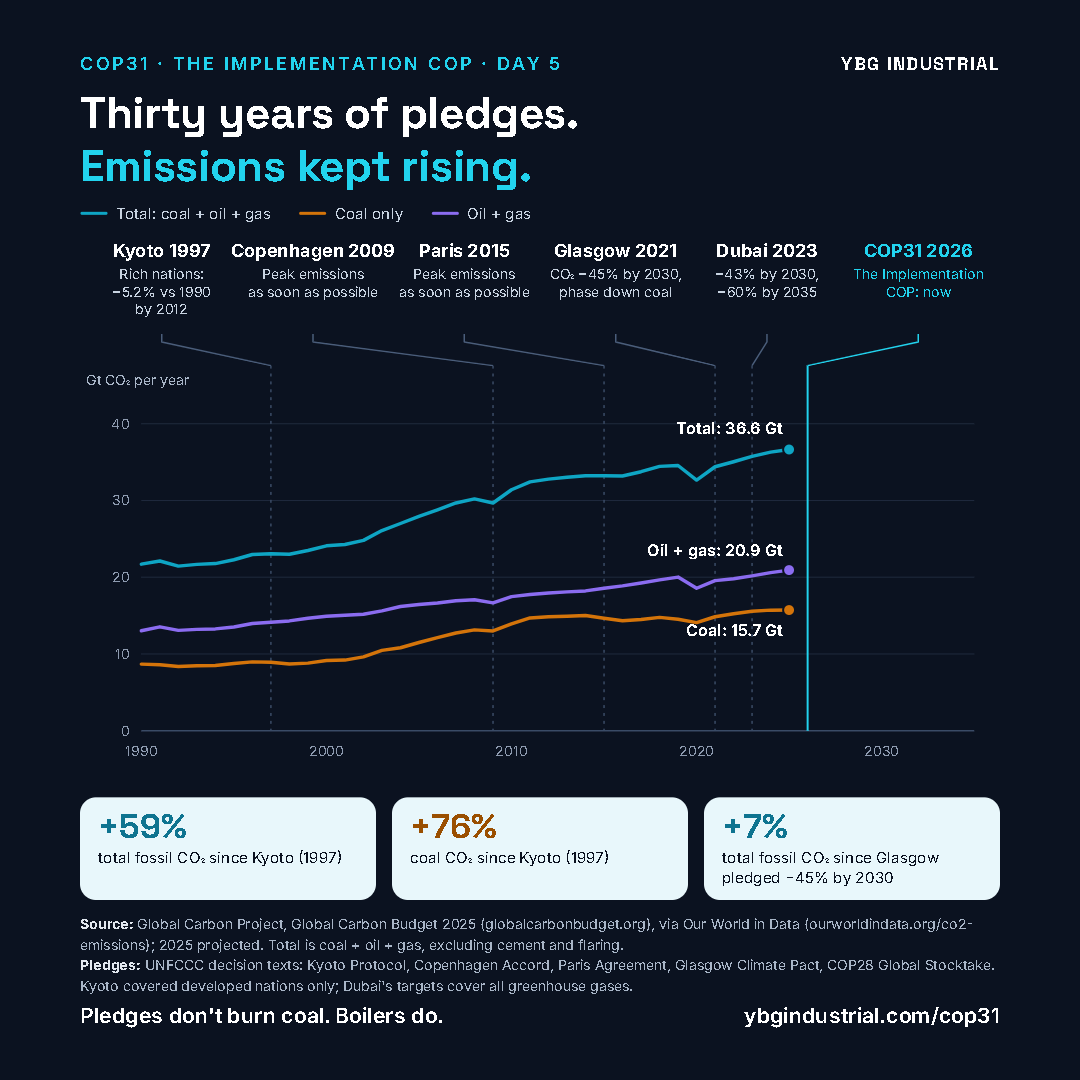
Every UN climate conference since Kyoto has produced a pledge:
- Kyoto, 1997: developed nations to cut emissions 5.2% below 1990 levels by 2012.
- Copenhagen, 2009: global emissions to peak as soon as possible.
- Paris, 2015: global emissions to peak as soon as possible, holding warming well below 2°C.
- Glasgow, 2021: CO₂ down 45% by 2030 from 2010 levels, and a phase-down of unabated coal power.
- Dubai, 2023: emissions down 43% by 2030 and 60% by 2035 from 2019 levels, and a transition away from fossil fuels.
Over the same period, CO₂ from coal, oil and gas rose from 23.1 billion tonnes in 1997 to an estimated 36.6 billion tonnes in 2025, an increase of 59%. Coal alone rose 76%, to 15.7 billion tonnes. Since Glasgow agreed to cut CO₂ 45% by 2030, emissions from fossil fuels have risen about 7%.
Targets have moved. Delivery hasn't followed.
The COP process has achieved something. Climate Action Tracker estimates that policies in place have lowered projected warming this century from about 3.6°C before Paris to about 2.6°C today. But that progress has largely stalled for four years, and actual emissions are still rising. COP31 in Antalya calls itself the Implementation COP. The record shows why that word matters.
Demand is rising faster than clean supply.
The underlying driver is demand. The International Energy Agency reports that global energy demand grew 1.3% in 2025 and electricity demand about 3%, driven by buildings, industry, electric vehicles and data centres. Clean energy is growing quickly, but not fast enough to meet all of that new demand, so the gap is still filled by the boilers that already exist.
Making energy expensive is not a workable brake.
The 2022 energy price shock, driven mainly by supply disruption and Russia's invasion of Ukraine, fed directly into inflation and a cost-of-living crisis in many countries. Research suggests carbon pricing itself has added little to inflation, but the lesson of 2022 stands: policies that depend on higher energy prices to curb demand are politically hard to sustain.
Efficiency cuts emissions and costs together.
There is a lever that doesn't depend on higher prices: making existing plants burn their fuel more completely. Less fuel for the same output means lower emissions and lower operating costs at the same time, with no new capacity to build and no price rise passed on to consumers.
That is what HydroHub™ does. On-site oxyhydrogen (H₂ + O₂) is introduced into the combustion zone of existing boilers to improve combustion. In biomass process-steam boilers: 13% average steam-to-fuel ratio improvement across ten biomass-fired plants in seven Indian states, measured by YBG with client teams. Coal-fired utility units are the next step; that work is at the engineering stage and no coal result is claimed.
Pledges don't burn coal. Boilers do. Implementation can start with the plants already running.
The data
| Year | COP | Coal (Gt CO₂) | Oil + gas (Gt CO₂) | Total (Gt CO₂) |
|---|---|---|---|---|
| 1997 | Kyoto | 8.9 | 14.1 | 23.1 |
| 2009 | Copenhagen | 13.0 | 16.7 | 29.7 |
| 2015 | Paris | 14.7 | 18.6 | 33.2 |
| 2021 | Glasgow | 14.8 | 19.6 | 34.4 |
| 2023 | Dubai | 15.6 | 20.2 | 35.7 |
| 2025 | COP31 (projected) | 15.7 | 20.9 | 36.6 |
Total is coal + oil + gas, excluding cement and flaring. 2025 is a projection.
Sources
- Global Carbon Project, Global Carbon Budget 2025, via Our World in Data: https://ourworldindata.org/co2-emissions
- UNFCCC decision texts: Kyoto Protocol (1997), Copenhagen Accord (2009), Paris Agreement (2015), Glasgow Climate Pact (2021), First Global Stocktake decision, COP28 (2023).
- Climate Action Tracker, Warming Projections Global Update, November 2025: https://climateactiontracker.org/publications/warming-projections-global-update-2025/
- International Energy Agency, Global Energy Review 2026: https://www.iea.org/news/global-energy-demand-growth-was-met-by-diverse-range-of-sources-in-2025-led-by-solar-and-then-gas
- International Energy Agency, Global Energy Crisis: https://www.iea.org/topics/global-energy-crisis
- Konradt, McGregor and Toscani, Carbon Prices and Inflation in the Euro Area, IMF Working Paper WP/24/31 (2024): https://www.imf.org/en/Publications/WP/Issues/2024/02/09/Carbon-Prices-and-Inflation-in-the-Euro-Area-544465