
Hydrogen inhalation is attracting increasing attention from researchers, healthcare professionals and consumers. Yet one figure appears repeatedly in discussions about hydrogen inhalation machines: 4% hydrogen.
It is often presented as though 4% were a medically established maximum, a prescribed therapeutic concentration or a universally accepted limit for hydrogen inhalation.
That interpretation needs clarification.
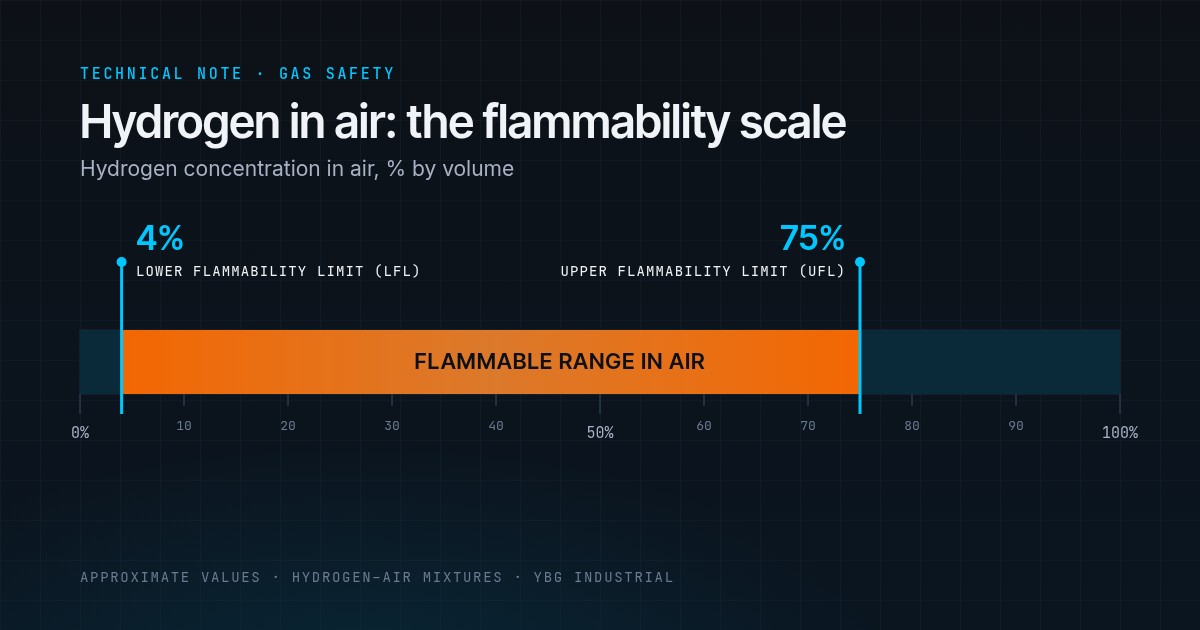
The 4% figure originates primarily from the physical behaviour of hydrogen when mixed with air. It is commonly quoted as the lower flammability limit (LFL): the approximate concentration at which a hydrogen–air mixture can become capable of supporting combustion under specified conditions.
It is therefore an important engineering safety parameter. It is not, by itself, a medically established therapeutic dose or a universal clinical limit.
Understanding the difference requires looking at three separate disciplines:
- Hydrogen's physical and combustion properties.
- Clinical research into hydrogen inhalation.
- The engineering principles used to generate, control and deliver hydrogen-containing gases.
1. Where does the 4% hydrogen figure come from?
Hydrogen is a combustible gas. When mixed with air, it can form a flammable mixture across a relatively broad concentration range.
The commonly quoted limits are approximately:
| Parameter | Hydrogen concentration in air |
|---|---|
| Lower flammability limit (LFL) | 4% by volume |
| Upper flammability limit (UFL) | 75% by volume |
The lower flammability limit is the approximate concentration below which a hydrogen–air mixture will not sustain flame propagation under the specified test conditions.
This is a physical property of the gas mixture.
It is not a measurement of the concentration required to produce a biological effect, nor does it establish an optimum concentration for human inhalation.
The distinction is important:
A flammability limit describes combustion behaviour. A therapeutic dose describes biological exposure. They answer different questions.
However, this does not mean that the 4% figure can be ignored when designing an inhalation device. It is a significant safety reference, particularly where hydrogen is mixed with air, accumulates in a reservoir or passes through equipment in which ignition could occur.
For that reason, keeping hydrogen-in-air concentrations below this approximate threshold is a common conservative engineering approach.
It is worth being precise about what "below" means. A nominal 4% hydrogen–air mixture is not below the lower flammability limit. It sits at approximately the limit. Manufacturing tolerances, concentration variation and local mixing conditions all mean that some parts of a nominally 4% mixture can be at or above the flammable threshold. A device that deliberately delivers hydrogen at 4% cannot simply claim to have eliminated flammability hazards. It must demonstrate that local concentrations, transient conditions and foreseeable faults cannot create a flammable mixture. Conservative engineering keeps a clear margin below the limit, not a target at it.
The correct conclusion is not that 4% is irrelevant. It is that its role must be understood correctly.
2. What have human clinical studies investigated?
Clinical research provides an important perspective because researchers have investigated hydrogen inhalation using different gas compositions and delivery arrangements.
One notable example is a multicentre, randomised, double-blind clinical trial conducted in China involving patients experiencing acute exacerbations of chronic obstructive pulmonary disease (COPD).
The study investigated a hydrogen–oxygen mixture containing approximately:
- 66.7% hydrogen.
- 33.3% oxygen.
The gas was delivered at a total flow rate of 3 litres per minute, comprising approximately 2 litres per minute of hydrogen and 1 litre per minute of oxygen, for 6–8 hours per day over seven days, compared with an oxygen control group.
The study is significant here because it shows that clinical researchers have investigated hydrogen concentrations substantially above 4%.
However, an important distinction must be made.
The researchers were administering a hydrogen–oxygen mixture, not hydrogen diluted in air. These are different gas compositions with different combustion characteristics.
The trial also used specific equipment, clinical supervision and safety testing. The researchers reported that the maximum hydrogen concentration measured in the surrounding confined space during testing was 0.8% after two hours of continuous operation.
This was an environmental safety measurement, not the hydrogen concentration being inhaled by the patients.
The study does not establish that a 66.7% hydrogen mixture is appropriate for general consumer use, and a single clinical trial does not establish broad therapeutic efficacy.
It does, however, show why the distinction between gas composition, clinical concentration and engineering safety matters.
Read the published COPD clinical trial. The published paper reports the trial's clinical outcomes in full. This note discusses only the gas composition, delivery and safety aspects of the study and makes no claims about health outcomes.
3. Hydrogen-in-air versus oxyhydrogen
Two different approaches to hydrogen gas delivery are sometimes discussed together, although their engineering characteristics are fundamentally different.
Hydrogen diluted in air
In this arrangement, hydrogen is mixed with air before or during delivery.
The resulting hydrogen concentration depends on the hydrogen generation rate, the air supply, the mixing arrangement and the user's breathing pattern.
The 4% lower flammability limit is directly relevant to hydrogen mixed with air.
Hydrogen–oxygen mixtures (oxyhydrogen)
Water electrolysis can produce hydrogen and oxygen in an approximately 2:1 volumetric ratio.
The resulting mixture contains approximately:
- 66.7% hydrogen.
- 33.3% oxygen.
This is commonly referred to as oxyhydrogen.
It is not equivalent to hydrogen diluted in air. It is a highly combustible hydrogen–oxygen mixture and requires a different approach to hazard analysis, gas handling and system protection.
The 4% hydrogen-in-air lower flammability limit must not be applied as though it were the safety threshold for this mixture.
| Hydrogen diluted in air | Oxyhydrogen (H₂ + O₂) | |
|---|---|---|
| Typical composition | Hydrogen at a few percent, balance air | ~66.7% hydrogen, ~33.3% oxygen |
| Is the 4% LFL the relevant reference? | Yes | No |
| Combustion hazard | Increases as concentration approaches the flammable range | Highly combustible as generated |
| Safety approach | Concentration control, mixing, ventilation | Full hazard analysis, flashback protection, minimal gas inventory |
The distinction is particularly important when interpreting published clinical research involving hydrogen–oxygen delivery systems.
4. What can industrial oxyhydrogen engineering teach us?
Industrial applications provide another useful perspective on hydrogen generation and gas management.
At YBG Industrial, our work with HydroHub™ concerns the controlled generation and application of oxyhydrogen in industrial combustion environments.
The engineering objective is not to store large quantities of hydrogen or oxyhydrogen for later use.
Instead, the system generates gas on demand, at the point of application, while the host industrial process is operating.
The architecture incorporates controlled gas generation, conditioning, metering, protective devices and interlocks. Integration with the host plant's burner-management and safety systems is an important part of the engineering approach.
This illustrates a broader engineering principle:
The safety of a gas application depends on the complete system architecture—not simply the percentage concentration of a gas.
Generation rate, gas inventory, mixing, pressure, ventilation, ignition sources, materials, monitoring, shutdown arrangements and operating procedures all matter.
HydroHub™ is an industrial combustion technology. It is not an inhalation device, and its industrial application does not establish the safety or suitability of any hydrogen inhalation product.
Nevertheless, industrial engineering experience demonstrates why hydrogen systems should be assessed as complete systems rather than by reference to a single concentration figure.
5. Why the gas delivery system matters
Any hydrogen gas system should be evaluated as a complete system, not solely by its advertised hydrogen concentration.
Where the flammability hazard actually is
The flammability concern in hydrogen inhalation is principally outside the human body: in the generator, the delivery pathway, any gas reservoir and the surrounding room. It is not primarily a concern that hydrogen will ignite in the lungs, which are not an ignition environment.
Separating hydrogen from oxygen at the point of generation, as PEM electrolysis does, removes the premixed hydrogen–oxygen hazard of conventional oxyhydrogen generation. But separation is only the first stage of safety engineering. Pure hydrogen in a delivery tube cannot burn on its own, because there is no oxidiser. A flammable mixture forms only if air or oxygen enters the hydrogen pathway, through a leak, a faulty connection or reverse flow. Preventing air ingress and backflow is therefore as important as how the hydrogen is generated.
Stored gas: why reservoirs deserve scrutiny
There are two broad delivery approaches:
- Generate hydrogen on demand and deliver it directly, with no significant stored gas.
- Generate hydrogen, mix it with air and accumulate the mixture in a breathing reservoir before delivery.
A reservoir can help accommodate the difference between a generator's steady output and a person's variable breathing. But it also creates a stored inventory of combustible gas inside the equipment.
| Reservoir volume | Hydrogen concentration | Hydrogen stored in the reservoir |
|---|---|---|
| 3,000 mL | 4% | ~120 mL |
| 3,000 mL | 2% | ~60 mL |
| 3,000 mL | 1% | ~30 mL |
At 4%, that stored mixture is at approximately the lower flammability limit. A reservoir-based design should therefore be able to show:
- the actual hydrogen concentration inside the reservoir, measured, not calculated;
- whether hydrogen can accumulate above the nominal concentration during filling, breathing or faults;
- how air, oxygen or exhaled gas is prevented from entering the reservoir or flowing back towards the generator;
- how the reservoir and its surroundings are protected against ignition, and what happens if it leaks or ruptures.
None of this means reservoirs are inherently unsafe. Reservoirs have legitimate uses in respiratory equipment. It does mean that the stored gas inventory is one of the most important features to examine.
General principles for any hydrogen delivery arrangement
- Gas inventory: the less stored combustible gas in the system, the lower the potential hazard.
- Composition: the gas composition should be known and consistent throughout the delivery path.
- Flow direction: the system should prevent air ingress and reverse flow back towards the generator.
- Ignition protection: the design should protect against ignition and flashback.
- Fault behaviour: the system should respond safely to foreseeable faults, such as a blocked outlet.
- Testing: the complete system should be tested under normal and foreseeable abnormal operating conditions.
A published concentration specification is not a substitute for evidence of the safety of the complete delivery system.
6. Is 4% the correct hydrogen inhalation concentration?
There is no basis for treating 4% as a universally established medical prescription.
The concentration used in a clinical investigation depends on the research question, gas composition, delivery method, exposure duration, participant population and safety controls.
For example, a 2021 study published in Critical Care Explorations investigated prolonged inhalation of 2.4% hydrogen in medical air in eight healthy adults, delivered by high-flow nasal cannula.
Participants were exposed for 24, 48 or 72 hours under hospital supervision. The researchers reported no clinically significant adverse events in this small study.
This is a useful example of research into hydrogen diluted in air, as distinct from the hydrogen–oxygen mixture used in the COPD trial.
Read the published 2.4% hydrogen safety study. The published paper reports the study's full methods and findings.
Neither study establishes a universal therapeutic concentration.
It is also important to distinguish between a concentration measured at the device outlet and the actual fraction of hydrogen a person inhales. Breathing patterns, gas flow rates and delivery arrangements all affect the concentration reaching the respiratory tract.
Consequently, a meaningful assessment requires more than a single percentage printed on a product specification.
7. The engineering question: safety, delivery and evidence
Hydrogen inhalation technology sits at the intersection of several disciplines.
A properly informed assessment should consider three separate questions.
First: What is the gas composition?
Is the system delivering hydrogen diluted in air, hydrogen mixed with oxygen, or another gas arrangement?
Second: What is the engineering safety architecture?
How is the gas generated, mixed, delivered, monitored and controlled? What safeguards are provided against leakage, accumulation, reverse flow and ignition?
Third: What does the clinical evidence establish?
What concentration was investigated? In which population? For how long? Under what supervision? What outcomes were measured, and what limitations did the research identify?
These questions should not be collapsed into a single argument about whether hydrogen should be limited to 4%.
The 4% figure is an important reference for hydrogen–air flammability. It is not a universal medical prescription. Equally, the existence of clinical research using higher hydrogen concentrations in hydrogen–oxygen mixtures does not establish that high-concentration hydrogen inhalation products are inherently safe.
Engineering safety and clinical efficacy must be assessed independently.
Conclusion: Understand the concentration before judging the technology
The growing interest in hydrogen inhalation makes accurate technical information increasingly important.
The 4% figure is widely quoted because it relates to the lower flammability limit of hydrogen in air. It should be understood as an engineering safety reference, not misrepresented as a medically prescribed therapeutic concentration.
Clinical researchers have investigated different hydrogen concentrations and gas compositions, including hydrogen–oxygen mixtures containing approximately 66.7% hydrogen. Other studies have examined lower concentrations of hydrogen diluted in medical air.
These approaches are not interchangeable.
The more useful question is not simply, "What percentage of hydrogen does the machine produce?"
It is:
What gas is being generated, how is it delivered, what safeguards are incorporated, and what does the relevant clinical evidence actually demonstrate?
That is the level of technical understanding required to evaluate hydrogen technology responsibly.
Frequently asked questions
Is 4% hydrogen a medical limit?
No. 4% is the approximate lower flammability limit of hydrogen in air, a physical property describing when a hydrogen–air mixture can support combustion. It is an engineering safety reference, not a medically established dose or a universal clinical limit.
What is the flammable range of hydrogen in air?
Approximately 4% to 75% hydrogen by volume. Below about 4%, a hydrogen–air mixture will not sustain flame propagation under standard test conditions.
Does the 4% limit apply to oxyhydrogen?
No. Oxyhydrogen is a hydrogen–oxygen mixture of roughly 66.7% hydrogen and 33.3% oxygen. It is highly combustible as generated and needs its own hazard analysis. The 4% hydrogen-in-air limit is not its safety threshold.
Have clinical studies used hydrogen concentrations above 4%?
Yes. A multicentre randomised trial in China used a hydrogen–oxygen mixture of about 66.7% hydrogen delivered at 3 litres per minute. Other research, such as a 2021 study in healthy adults, used 2.4% hydrogen in medical air. These are different gas compositions and the results are not interchangeable.
Is a 4% hydrogen–air mixture safe from ignition?
Not automatically. 4% is approximately the lower flammability limit itself, not a safe margin below it. Local concentration variations, transients and faults can create flammable pockets, so systems operating near 4% must demonstrate their safety rather than assume it.
Where is the flammability hazard in hydrogen inhalation?
Mainly in the equipment and environment: the generator, delivery tubing, any gas reservoir and the surrounding room. Pure hydrogen cannot burn without oxygen, so the key risks are air or oxygen entering the hydrogen pathway, and stored combustible gas in reservoirs.
Is HydroHub™ an inhalation device?
No. HydroHub™ is an industrial oxyhydrogen system for combustion processes. It is not intended for human inhalation, and its industrial use does not establish the safety or suitability of any inhalation product.
References
Clinical outcomes, where reported, are available in full in the original publications below. This note does not summarise or make claims about them.
- Zheng ZG, et al. Hydrogen/oxygen therapy for the treatment of an acute exacerbation of chronic obstructive pulmonary disease: results of a multicenter, randomized, double-blind, parallel-group controlled trial. Respiratory Research, 2021. https://pmc.ncbi.nlm.nih.gov/articles/PMC8120708/
- Cole AR, Sperotto F, DiNardo JA, Carlisle S, Rivkin MJ, Sleeper LA, Kheir JN. Safety of Prolonged Inhalation of Hydrogen Gas in Air in Healthy Adults. Critical Care Explorations, 2021;3(10):e543. https://doi.org/10.1097/CCE.0000000000000543
About YBG Industrial
YBG Industrial develops and applies industrial oxyhydrogen technology through its HydroHub™ platform.
Our focus is controlled, on-demand gas generation and the engineering integration of oxyhydrogen into industrial combustion processes.
Industrial oxyhydrogen applications are distinct from consumer hydrogen inhalation products and are not intended for human inhalation.
Explore our industrial technology:
Read how the HydroHub™ platform is built, explore the technical notes on its engineering and measurement, and learn about YBG and the engineering team.
This article is provided for technical and educational purposes. It is not medical advice, a recommendation to use hydrogen inhalation equipment or a substitute for a device-specific engineering safety assessment.