
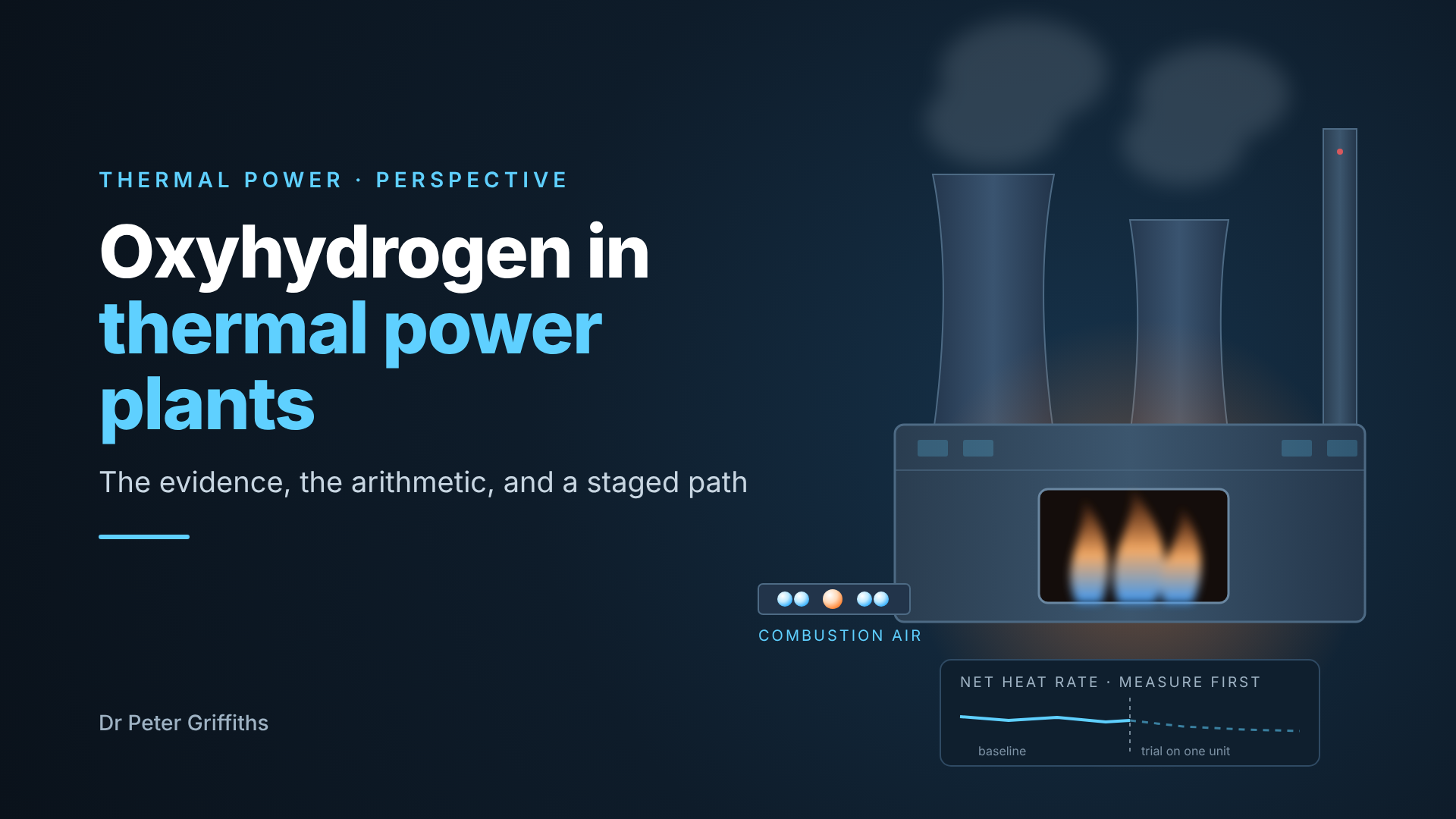
Thermal power plants live and die by heat rate. On a large unit, a fraction of a percent of fuel is worth a great deal of coal, and a meaningful reduction in emissions. That's why combustion enhancement deserves a serious look from utilities, and why it deserves serious scrutiny too.
How it works in a utility boiler
An oxyhydrogen generator splits water into hydrogen and oxygen, on demand, beside the boiler. Nothing is stored. The gas is introduced into the combustion air, not the fuel line, so the mills, burners and fuel handling stay as they are. Hydrogen's fast flame speed helps pulverised coal burn more completely, and the added oxygen can allow tighter control of excess air. The energy in the oxyhydrogen itself is small; any benefit has to come from better combustion of the coal.
What has been shown, and what hasn't
On a ten-plant biomass-fired process steam fleet in India, our engineers measured an average 13% improvement in steam-to-fuel ratio, working with the client's plant teams. That is a real result on biomass process-steam boilers.
It is not a utility-scale coal result, and we don't present it as one. No large-scale independent field study yet exists for electrolytic oxyhydrogen co-firing in commercial coal-fired utility boilers. To our knowledge, no vendor, YBG included, currently operates an integrated system above 100 TPH equivalent capacity. Published CFD and pilot-scale studies support the combustion science, but that is not the same as a utility-scale field result.
| Evidence already reported | What it does not show |
|---|---|
| 13% average steam-to-fuel improvement across ten biomass-fired process steam plants in India: biomass process-steam results reported by the vendor's engineers, measured with the client's plant teams. | Not utility-scale coal evidence. |
| Published CFD and pilot-scale studies support the combustion science. | Not a utility-scale field result. No large-scale independent field study yet exists for electrolytic oxyhydrogen co-firing in commercial coal-fired utility boilers. |
| To our knowledge, no vendor, YBG included, currently operates an integrated system above 100 TPH equivalent capacity. | An integrated system above that capacity has not been demonstrated in the operating systems described here. |
The arithmetic is different in a power plant
In an industrial plant, the generator's electricity is bought from the grid. In a power plant, it comes from the plant's own output, as auxiliary power, and it reduces net generation.
So the test is simple: the fuel saved must be worth more than the fuel it took to generate the generator's electricity. With a unit converting fuel to electricity at about 35% efficiency, each kWh the generator uses represents roughly 2.9 kWh of fuel. The enhancement only pays if the fuel saved exceeds that, measured on net heat rate, not gross.
| Example input or calculation | Energy basis |
|---|---|
| Example plant efficiency | About 35% |
| Example system electrical energy used, including auxiliaries | 1 kWh electricity |
| Fuel energy used to generate that electricity | 1 ÷ 0.35 ≈ 2.9 kWh fuel |
| Fuel energy that must be saved to break even | Roughly 2.9 kWh fuel; savings must exceed this to produce a net benefit |
This example compares energy only, using the article's approximate efficiency assumption; it is not a measured saving or a complete cost calculation. Real results are site-specific and must be assessed on net heat rate.
What a utility should measure
- Net and gross heat rate, before and after, under comparable load.
- Boiler efficiency by the heat-loss method: flue gas O₂ and temperature, CO, and unburnt carbon in fly ash and bottom ash.
- The generator's total electrical input, including auxiliaries, charged against net output.
- Emissions as measured at the stack by the plant's own instruments.
A staged path
- Data review: coal quality, unburnt carbon, excess air and current heat rate. Some units are good candidates; some aren't.
- Agree the metric and the test method in writing before anything is installed.
- Engineer it properly: HAZOP and SIL/LOPA studies, flashback arrestors, non-return valves, gas detection with automatic shutdown, and interlocks to the FD fan and flame status.
- Start with one unit, or an auxiliary boiler, and measure.
- Scale only on measured results.
The bottom line
Oxyhydrogen combustion enhancement is combustion engineering, and in a power plant it must be judged on net heat rate, measured on the unit it is installed on. Utilities that want to explore it should start with data, not equipment.
If you operate a thermal power fleet and want to explore a measured first unit, I'm happy to start with your data.
I'm the founder of YBG Group International, which supplies HydroHub™ oxyhydrogen systems. Results are site-specific and not a guarantee of results at any other plant.
FAQ
Does oxyhydrogen reduce coal consumption in power plants?
Any benefit has to come from better combustion of the coal, not the small energy contribution of the oxyhydrogen itself. In a power plant, fuel savings must exceed the fuel used to generate the system's electricity, measured on net heat rate. Utility-scale coal results have not yet been demonstrated in a large-scale independent field study.
Has oxyhydrogen been proven at utility scale?
No large-scale independent field study yet exists for electrolytic oxyhydrogen co-firing in commercial coal-fired utility boilers. The ten-plant biomass process-steam result is not utility-scale coal evidence. Published CFD and pilot-scale studies support the combustion science, but are not utility-scale field results.
Why is the energy arithmetic different in a power plant than in an industrial boiler?
An industrial plant buys the generator's electricity from the grid. A power plant supplies it from its own output as auxiliary power, reducing net generation. At about 35% plant efficiency, each kWh of electricity represents roughly 2.9 kWh of fuel; fuel savings must exceed that energy cost, measured on net heat rate rather than gross heat rate.
What should a utility measure in an oxyhydrogen trial?
Measure net and gross heat rate before and after at comparable load; boiler efficiency by the heat-loss method using flue gas O₂ and temperature, CO, and unburnt carbon in fly ash and bottom ash; the generator's total electrical input including auxiliaries, charged against net output; and stack emissions using the plant's own instruments.
What does a staged oxyhydrogen trial look like?
Start with a data review of coal quality, unburnt carbon, excess air and current heat rate. Agree the metric and test method in writing before installation, engineer the safety studies and safeguards, then start with one unit or an auxiliary boiler and measure. Scale only on measured results.
Read how the HydroHub™ platform is built, explore the technical notes on its engineering and measurement, and learn about YBG and the engineering team.
References
- [PETER TO SUPPLY] — CFD studies mentioned in this note.
- [PETER TO SUPPLY] — Pilot-scale studies mentioned in this note.