
For most of my working life, oxyhydrogen has been surrounded by two kinds of noise. On one side, inflated claims of fuel savings that no engineer could reconcile with a heat balance. On the other, reflexive dismissal from people who had only ever seen the inflated claims.
I've worked with oxyhydrogen for four decades, beginning alongside Yull Brown in 1985. I've learned that the only way through that noise is to say plainly what has been shown, what hasn't, and how a plant owner can find out for themselves.
What it is, and where it goes
An oxyhydrogen generator splits water by electrolysis into hydrogen and oxygen, on demand, beside the boiler. Nothing is stored. The gas is used as it's made.
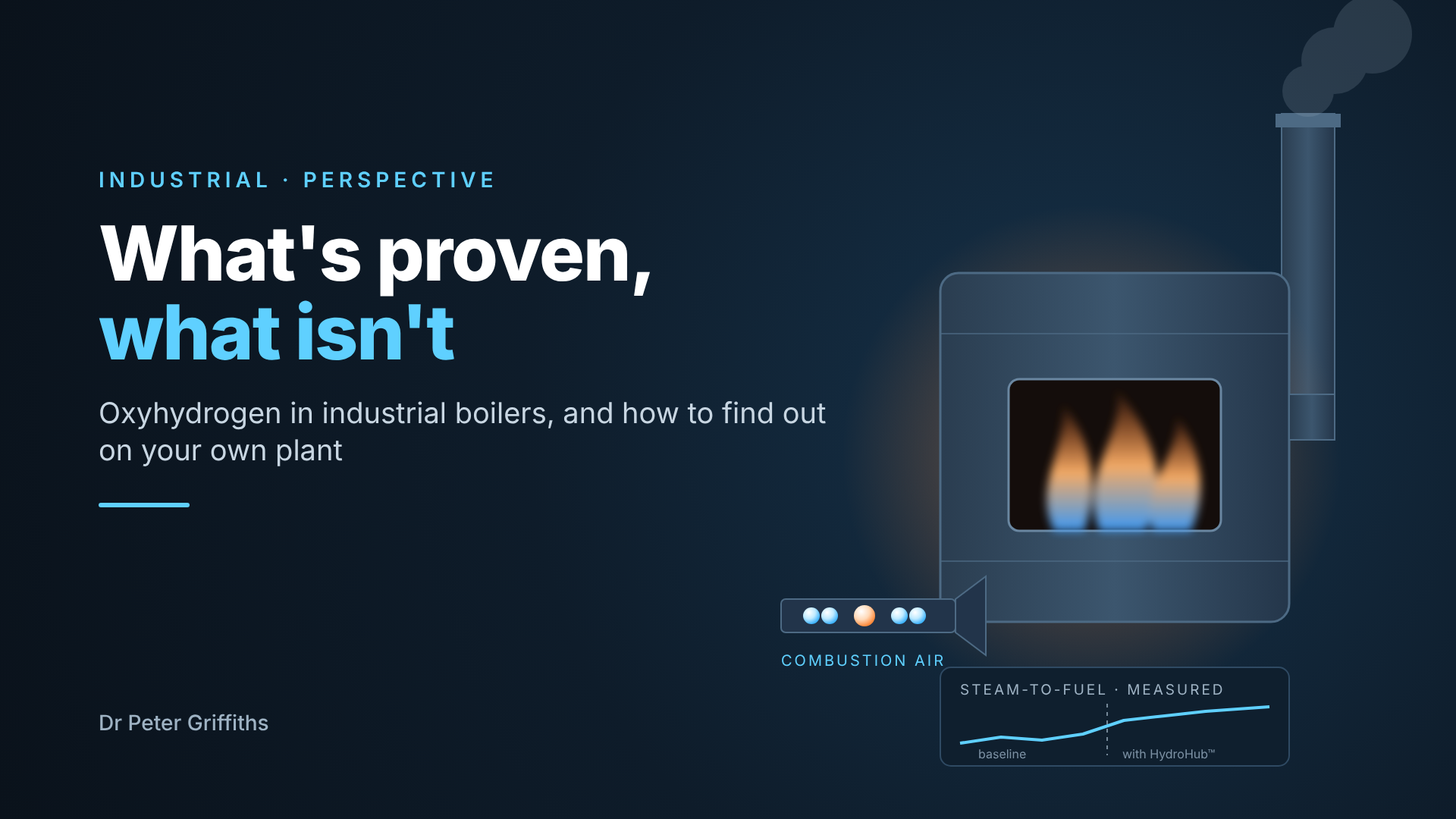
In our HydroHub™ systems, it's injected into the combustion air, not the fuel line. That choice matters. The fuel system, burner and fuel supply stay exactly as they are, and the oxyhydrogen acts on how the existing fuel burns. Hydrogen's fast flame speed and wide flammability range help the main fuel burn more completely and more evenly. The added oxygen can allow tighter control of excess air.
What it doesn't do is replace fuel in any meaningful quantity. The energy in the oxyhydrogen itself is small. Any gain has to come from better combustion of the coal, biomass or gas you already burn. A supplier who tells you otherwise is asking you to ignore the heat balance.
What has been shown
Across a ten-plant biomass-fired process steam fleet in seven Indian states, our engineers measured an average 13% improvement in steam-to-fuel ratio, working together with the client's plant teams. The client reports that the savings paid back the installations in under two years at every site.
That's a real result, and I'm proud of it. It's also a result on biomass process-steam boilers. It isn't a result on a 500 MW coal unit, and I won't present it as one.
What hasn't been shown yet
There are two gaps any utility buyer should know about:
- No large-scale independent field study yet exists for electrolytic oxyhydrogen co-firing in commercial coal-fired boilers. Published CFD and pilot-scale work supports the combustion science, but that isn't the same as a utility-scale field result.
- No vendor, YBG included, currently operates an integrated system above 100 TPH equivalent capacity.
I say this openly because the next step for this technology is scale-up, and scale-up has to be built on honest baselines. If the industry repeats the mistakes of the past, overselling first and measuring later, it will set itself back another decade.
How to find out on your own plant
If you run boilers in power, cement, process steam, glass or textiles, this is the sequence I'd recommend, whoever your supplier is:
- Start with data, not equipment. Review fuel quality, steam output, flue gas oxygen and temperature, and unburnt carbon over a representative period. Some plants are good candidates; some aren't. An honest assessment should be willing to say "not this one".
- Agree the metric before anything is installed. Steam-to-fuel ratio, measured consistently before and after, is the simplest metric that can't be gamed. Agree the instruments, period and operating conditions in writing.
- Engineer it properly. That means HAZOP and SIL/LOPA studies, flashback arrestors, non-return valves, gas detection with automatic shutdown, and interlocks to the FD fan and flame status. Hydrogen deserves respect.
- Commit to results per site. Any performance commitment should be made after assessment, on the agreed metric, for that boiler. Never as a blanket number.
- Scale only on measured results. Prove one unit, then the fleet.
The bottom line
Oxyhydrogen combustion enhancement isn't magic, and it isn't snake oil. It's combustion engineering, and it should be judged the way all combustion engineering is judged: on measured data from the plant it's installed on.
If you're responsible for a boiler fleet and want to explore whether it fits, I'm happy to start with your boiler data.
I'm the founder of YBG Group International, which supplies HydroHub™ oxyhydrogen systems. Results are site-specific and aren't a guarantee of results at any other plant.